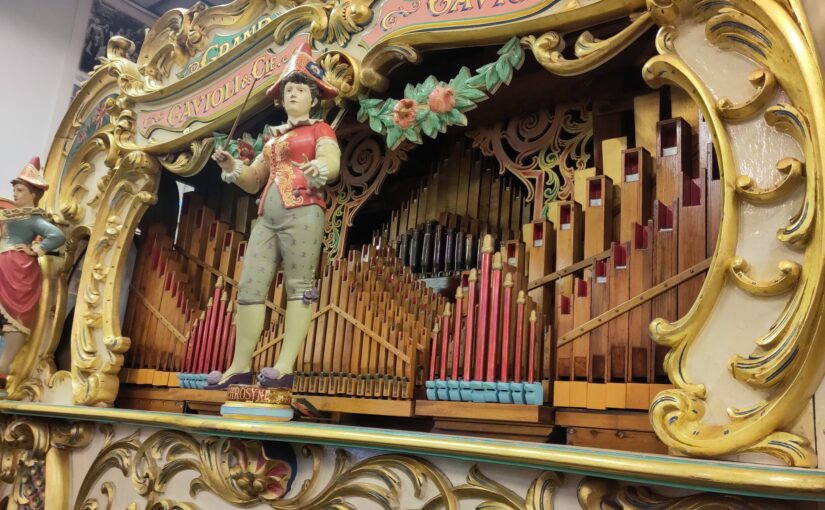
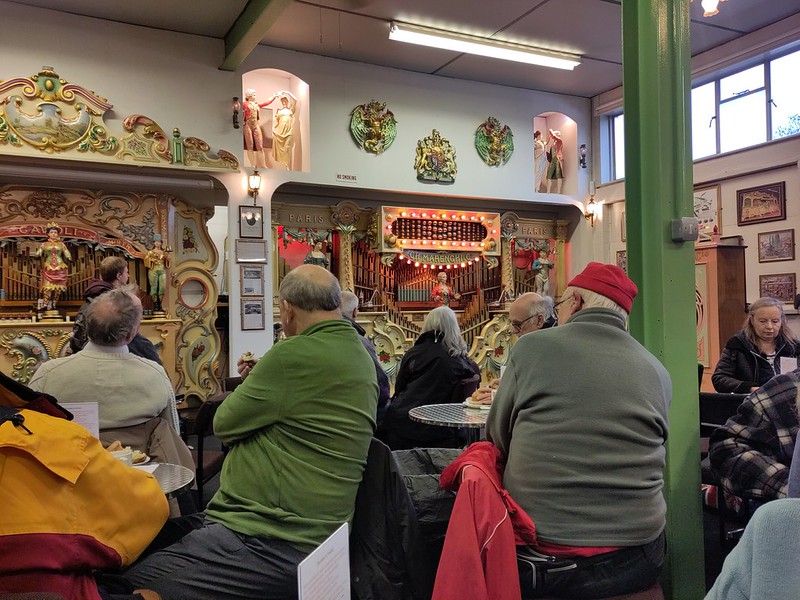
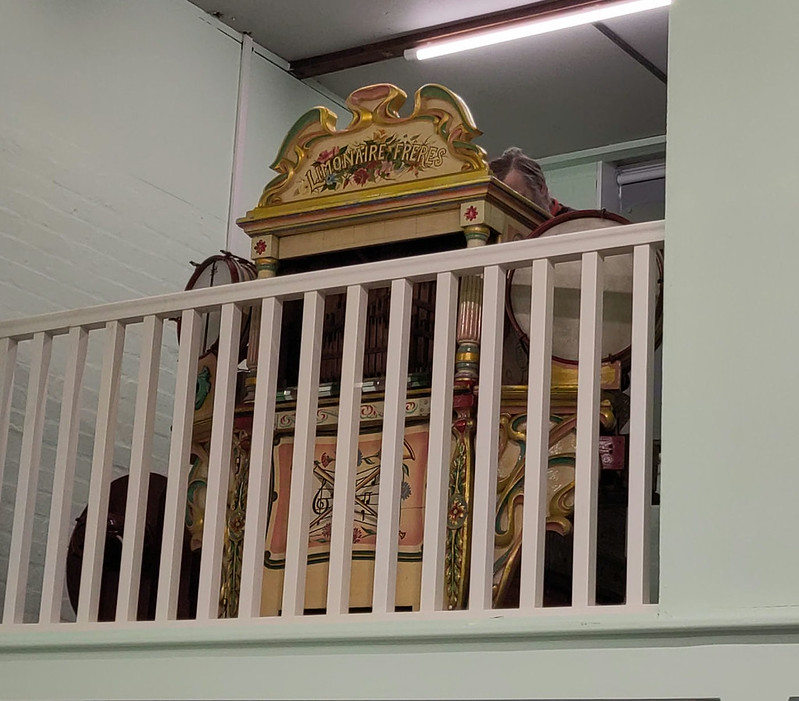
As winter is the off-season for organ grinding, the only event in January’s BOGA calendar was the open day at the Amersham Fair Organ Museum. This monthly event is free. The museum is set up like a giant cafe, filled with round tables and with a kiosk near the door selling sandwiches, tea and cake. Visitors buy their snack and settle at a round table in a large room surrounded by the loudest fair organs you have ever heard in your life.
The musical selection was highly varies Britania Rules to Waves, Onward Christian Soldiers, Rah Rah Rasputin, a Beatles song and many things I did not recognise. The major unifying factor is that everything seemed to be more than 30 years old.
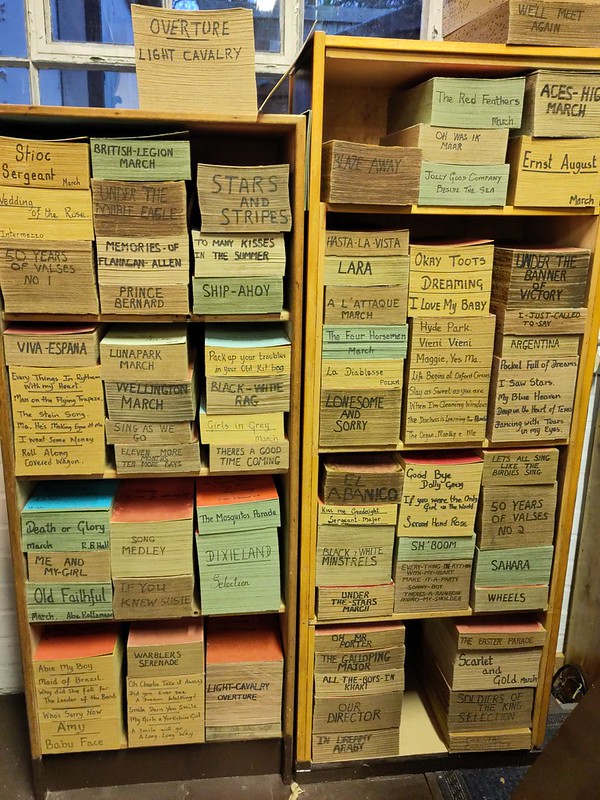
The music was mostly played off of “books”. This is a format very similar to a piano roll, but in an organ-specific format for hole punching. Rather than being played from a spool, the holes are punched into tougher card, which is folded in a butterfly / Z form, so one card proceeds to the next. The start in a neat pile and finish in a neat pile. Using this format rather than scrolls allows for the use of thicker material and also allows arrangements to be arbitrarily long. This layout method was invented by Gavioli.
They were the makers of many of the organs at the Amersham Fair Organ Museum, was a Franco Italian venture that worked in both countries. It was Anselme Gavioli, heir to the family business, who invented and patented the book format.
I had the impression that Gavioli was really the major organ manufacturer of their heyday, but according to Wikpedia, they mostly survive in the UK.
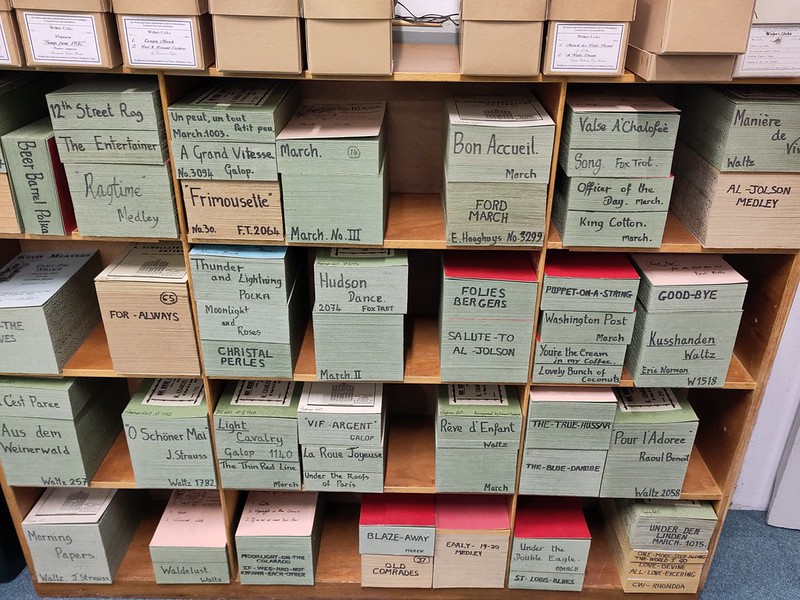
Gavioli shut down in 1912, so many of of the books on the second shelf post-date the company that invented them.
By that time, they had moved to France and organ grinding in general had lost its association with Italians, which perhaps explains why there are so many German songs.
In the late Victorian period, as organ busking was a major form of employment for Italian migrants, London streets were also full of German brass bands. The large format organs have the presence of a full band and, indeed, many full band pieces are in their repertoire. For example, on the shelf you’ll see The Washington Post March, by Sousa – an American. The old German pieces may have made their way to big organs. As for polkas, they were already part of street organ repertoire.
One of the larger books on the shelf is an Al Jolson medley. was the star of The Jazz Singer and was the biggest star of the 1910s and 20s. He is best remembered now for performing in blackface. However, he was extremely popular at the time and his ‘style was “arguably the single most important factor in defining the modern musical.” ‘ (Wikipedia) Jolson was a migrant to the US from what is now in Lithuania in 1894 – part of a massive wave of Jewish immigration of people fleeing violence. [Obligatory Spivak reference goes here.] Anyway, there’s some minstrelsy archived in Amersham.
As to the organs themselves, the larger organs seem to be intended to mimic large brass or marching bands, in terms of amplitude, repertoire and available timbres. I only saw one relatively small organ, which was still bigger than mine. Like the MIDI repertoire that came with mine, the arrangements seemed to be based on wind ensemble, crossed with player piano.
Clowns
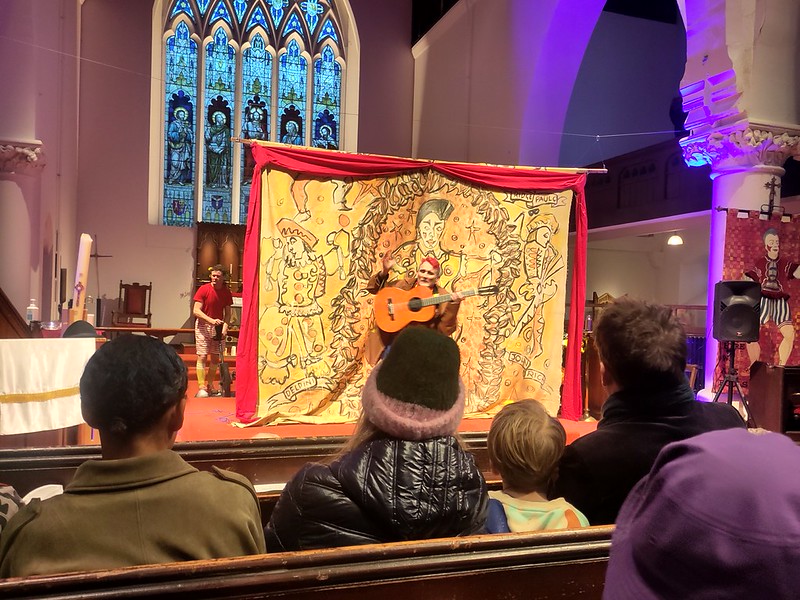
Tthe 80th Annual Grimaldi Service took place on Sunday 1 February 2026, at All Saints Church in Haggerston. This is not the clown’s church. The Grimaldi service is too popular to fit in that smaller venue.
This turned out to really just be a mass but with some clowns in it. It had all the normal elements of a mass, but with some honking during the breaks. Before the service, the organist played some slow moving music with midrange drones. It was not at all like fair organ music. The opening hymn was Tis a Gift to be Simple but with the Shaker lyrics, Lord of the Dance, which are unfortunately seared into my brain from Catholic school.
One of the main readings was from Ecclesiastes, the list of binary oppositions. This was also a major theme of the homily and I guess the idea of clowns in church. I suspect there was intention to have this holding of opposites be an element in a joyful memorial mass. However, this is fairly normal in US culture where people have “celebrations of life” rather than “sad” funerals, because grief is a failure under neoliberalism. It’s too hard to constrain. It doesn’t make people into better workers but instead feeds an implicit, emotional demand for justice. Grief must be denied.
Christianity, which co-developed with neoliberalism and is the major spiritual underpinning of the ideas within it, is all too willing to accommodate this. Your friends will be back as soon as Jesus finishes his brief holiday.
Instead, clowning itself provides the rupture, making space for grief and complicated joy. Clowning is queer. Clowning disrupts or at least complicates power structures. Clowning has much more spiritual potential than anything the CoE has to offer.
![Let Us now remember all who have served in this profession and have passed beyond this life.
All: Rest eternal grant unto them O Lord / May they rest in peace.
All: Rise in glory. Amen.
The clowns will say the Clowns prayer
Dear Lord, I thank you for calling me to share with others your most precious gift of laughter.
May I never forget that it is your gift, and my privilege. As your children are rebuked in their self-importance and cheered in their sadness, help me to remember that your foolishness is wiser than our wisdom. Amen.
Act of dedication, said by all
O Lord, our G-d, we acknowledge you as our Father, ourselves as your children, our neighbours as our brothers and sisters.
We dedicate ourselves to your obediance and to the service of others and to our hearts and our minds, our wills and our work in the power of the Holy Spirit and in the name of JC etc Amen
[Lord's prayer follows]](https://www.celesteh.com/blog/wp-content/uploads/2026/03/image-scaled.png)
Anyway, I felt alienated by the Christianity, as I should have known I would. The bake sale had nothing vegan. But at least there was a clown show afterwards.
Queer Theory
Has been moved to it’s own post, but I don’t want to untangle the bibliography, so all of it is here.
Works Cited
Al Jolson (2026). Wikipedia [Online]. Available at: https://en.wikipedia.org/w/index.php?title=Al_Jolson&oldid=1341751665 [Accessed: 9 March 2026].
Cabaret (1972).
Ecclesiastes 3:1 [Online]. Available at: https://www.sefaria.org/Ecclesiastes.3.1?lang=bi [Accessed: 9 March 2026].
Frankfurt, H.G. (2009). On bullshit.
Gavioli (2025). Wikipedia [Online]. Available at: https://en.wikipedia.org/w/index.php?title=Gavioli&oldid=1301641269 [Accessed: 9 March 2026].
Halberstam, J. (2011). The Queer Art of Failure. [Online]. Duke University Press. Available at: http://read.dukeupress.edu/books/book/1581/The-Queer-Art-of-Failure [Accessed: 10 February 2026].
Huston, W. (1985). The Greatest Love of All.
Hutchins, C. (2026). Newer-Looking Repertoire. [photo]. Available at: https://www.flickr.com/photos/celesteh/55038200962/ [Accessed: 9 March 2026].
Limonaire Frères (2025). Wikipedia [Online]. Available at: https://en.wikipedia.org/w/index.php?title=Limonaire_Fr%C3%A8res&oldid=1323198570 [Accessed: 9 March 2026].
Sartre, J.-P. (1948). Anti-Semite and Jew.
Spivak, G.C. (2023). Can the subaltern speak? In: Imperialism. Routledge, pp. 171–219.
The Crazy Clown Church Service That Happens Every February (2026). [Online]. Available at: https://londonist.com/london/things-to-do/clowns-church-service-hackney-february [Accessed: 9 March 2026].
