If the Italian stereotype was gone by the end of WW1, then what can we say about an opera written in WW2?
Toltz has the answers to my questions.
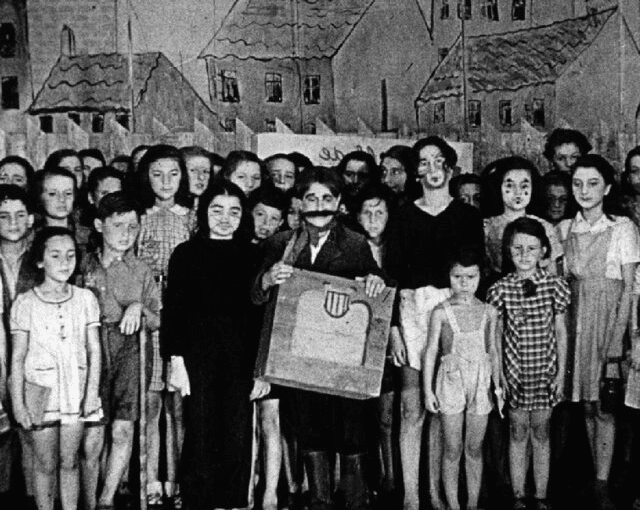
‘On 7 July 1943, Rudolf (Rudi) Freudenfeld . . . arrived in Terezín with his allotted fifty kilograms of luggage. Smuggled within was the piano score of Brundibár. In the camp, the score was re-orchestrated by the composer for the various instrumentalists who were available. Rehearsals were held in secret. The set, to Zelenka’s design, was constructed out of stolen wood; choreography was undertaken by Kamila Rosenbaum, a prominent modern dance exponent in Vienna prior to her transportation; and the premiere of the Terezín version took place on 23 September 1943, in the hall of the Magdeburg barracks. All in all, Brundibár was performed fifty-five times in Terezín up to the end of 1944, making it the most popular and most frequently performed work in the camp.’ (p 45)
Camp survivors, ‘Rind and Weissberger share an explicit agenda in exploring and commemorating Brundibár: exploring through personal collecting of recordings and information, commemorating it as speakers at performances, and advocating future performances of the work. They both hold the determined belief that the meaning of Brundibár, the simple message advocating an eventual triumph of good over evil, makes it all the more worthy for performance as a message of tolerance, one of the reasons they invest so much emotionally in the work. Both Rind and Weissberger also believe that performing Brundibár in a modern context commemorates the lives of the children who did not return from Auschwitz.’ (p 47)
And what of the use of an organ grinder as allegory? ‘Precise cultural understanding of the work is exceptionally important to Rind and, as well as pointing out the inadequacies of the current English translation, he also brings forth hidden meanings in the narrative. The character of Brundibár is an organ-grinder in the plot, and the cultural understanding of the role of organ-grinders in the post-World War I Republic of Czechoslovakia is crucial to Rind’s reading of the work. Organ-grinders were often wounded soldiers granted license to busk in their own particular area or canton and, when the children begin to busk on Brundibár’s turf, they transgress this adult rule, without being aware of it, and thus earn the ire of all the adults. Without this cultural understanding, the character of Brundibár could quite easily transform into a typical evil (outsider) caricature from fairytale or folklore. Rind’s contextualisation is therefore crucial in informing an accurate cultural reading of the story.’ (p 48)
Zooming out to an alternative reading, which I recognise is a fraught thing to do with a text with this history: The character of Brundibar, called a “dictator” in the English translation, is kind of a middle class figure. He was injured in service of the capitalist state and the military industrial complex, in such a way that made him “unfit” for further productive work. He has been granted a busking monopoly by the system, living in extreme precarity.
When children, more vulnerable than him, are also left without options other than busking, Brundibar fights to maintain the small amount of privilege he has been granted, acting the part of ‘dictator’ rather than siding with others exploited.
Brundibar therefore acts as a buffer between starving children and the adults with money who walk past them both. Therefore, the classes above the busking class are never actually threatened. All the action takes place in between the most vulnerable people in society. True revolution is never on the table, despite the revolutionary zeal of the youth.
The Shoah was a specific tragedy and one should avoid universalising, but a particular allegory in a particular play can possibly carry more baggage. Most productions on YouTube do seem to particularise it. Many have the children in it dressed in camp uniforms, to further tie it to the Shoah, even if this, itself is ahistorical. This particular camp was a showpiece for Nazi propaganda and, in documentary footage, the abductees did not wear uniforms. A well-produced Italian version transplants the set to Auschwitz.
I also found a British school production that seemingly made no reference to the play’s context and performed it as an opera with value in its own right as an artwork.
The moral of the play is defeating dictators and oppression through solidarity. This message is still timely and for this reason, I would argue that it’s valid to treat this as a living work, reinterpreted, restaged and sometimes recontextualised. The original context should never be erased or ignored, but part of “never again” does mean being vigilant now. Perhaps the in-between status of the Brundibar character reflects that the defeat of fascism is not just deposing one man, but an entire system and those who uphold it. That the “ordered liberty” some seek to impose makes everyone a dictator to those below them. All of these dictatorships must be overthrown.
Works Cited
Hans Krása (1938). Brundibár. [Opera].
Toltz, J. (2004). Music: An Active Tool of Deception?: The Case of’Brundibar’in Terezin. Context: Journal of Music Research:43–50.
