Antifascist Organ Grinding

Le Roi et l’Osieau is a French film which also features an organ grinder and a Hitler allegory – this time not in the same person. The film was in production from 1948 and had a partial release in 1952, but was not completed until it’s release in 1980(!). There also exists a ‘low-budget English-language release of the 1952 version, titled The Curious Adventures of Mr. Wonderbird, [which] is in the public domain and available free’ on archive.org. (Wikipedia)

I was only able to find the 1980 version in French, without subtitles. I was able to follow it because I had watched My Wonderbird first. The films contain large, sprawling stories, with a lot of plot, and a clockwork punk aesthetic. They have all the surrealism of Soviet children’s cinema, but (especially Wonderbird) also uses Disney-esque archetypes. With a king and a shepherdess, it has elements of a bucolic fairytale, but with a chimney sweep and organ grinder, this is intermixed with urban elements.

The king lives in a hyper modern police state, called Takicardie, surrounded by machinery – literal mechanisms of power – and guards. Although he is a fairytale character, his statement that “work is freedom” could not be a clearer allusion to Nazis and Auschwitz.

The heroes of the film are a chimney sweep and shepherdess who wish to marry, despite the king’s insistence the shepherdess should marry him. The narrator, a mocking bird, also plays a major role in the action.

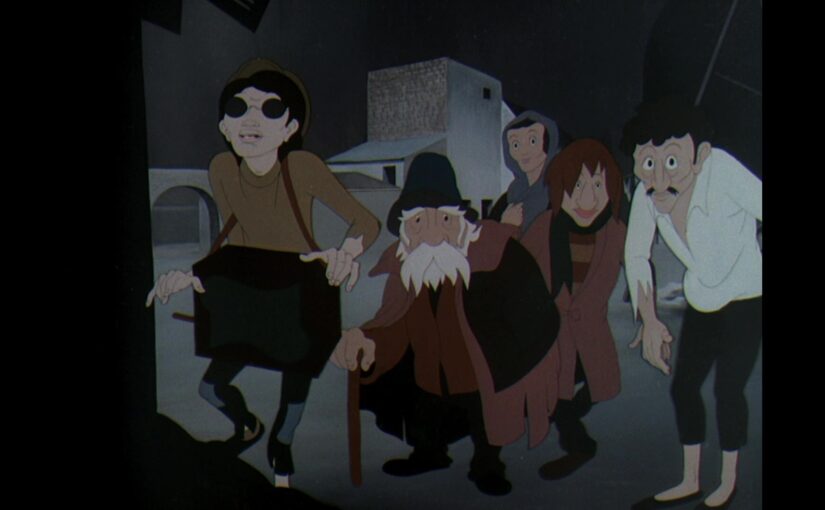
The organ grinder is a supporting character, introduced late in the narrative. He is subaltern, literally living in the underground. The proletariat is so alienated from their labour and the results thereof, that they know of the sun and birds only as fairytales.

The organ grinder
The organ grinder

As far as the sound design goes, the two films have some difference. Wonderbird uses music that could conceivably come from a busking organ for the organ scenes, whereas the later version treats the instrument more as a Victrola. For the scenes with the giant robot, in Wonderbird, the sound effects of the giant robot emphasise the sound of the machinery itself. Giant, grinding sounds and gears, as well as destruction, like breaking cement. In the 1980 version, the robot itself is quieter and the sounds of things breaking is foreground. Those are the sounds of wooden boards being dropped.

The earlier version (or perhaps anglophones?) envision the proletariat in modern blocks. Whereas the French in 1980 had them in historic wood-framed housing.

The later version also gives more clues as to the primary industry in the society, although this is present in both versions. The workers toil to produce representations of the king. All commerce is created directly in his image. Or is in service of his entertainment and power.
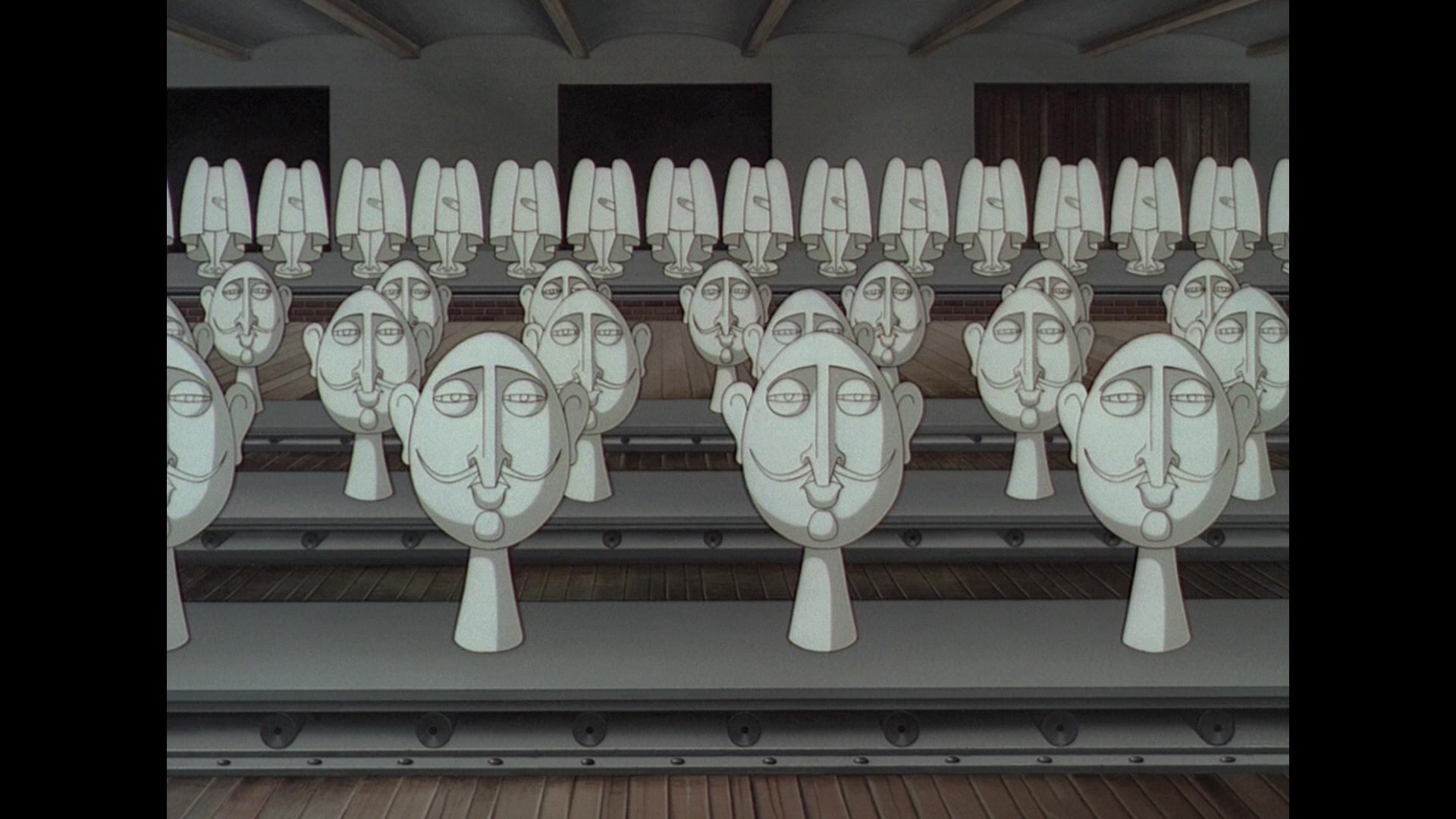
An assembly line of royal statues

There is therefore a strong resonance with generative AI. The ruling class creates its own image, without real meaning, over and over again.

In both versions, the organ grinder plays absolutely necessary political roles both in keeping the proletariat hopeful and ready to participate in the revolution, and also in winning over the king’s lions to rise against him. He is especially vital in playing for the lions, who would have eaten the main protagonists if not for his intervention.
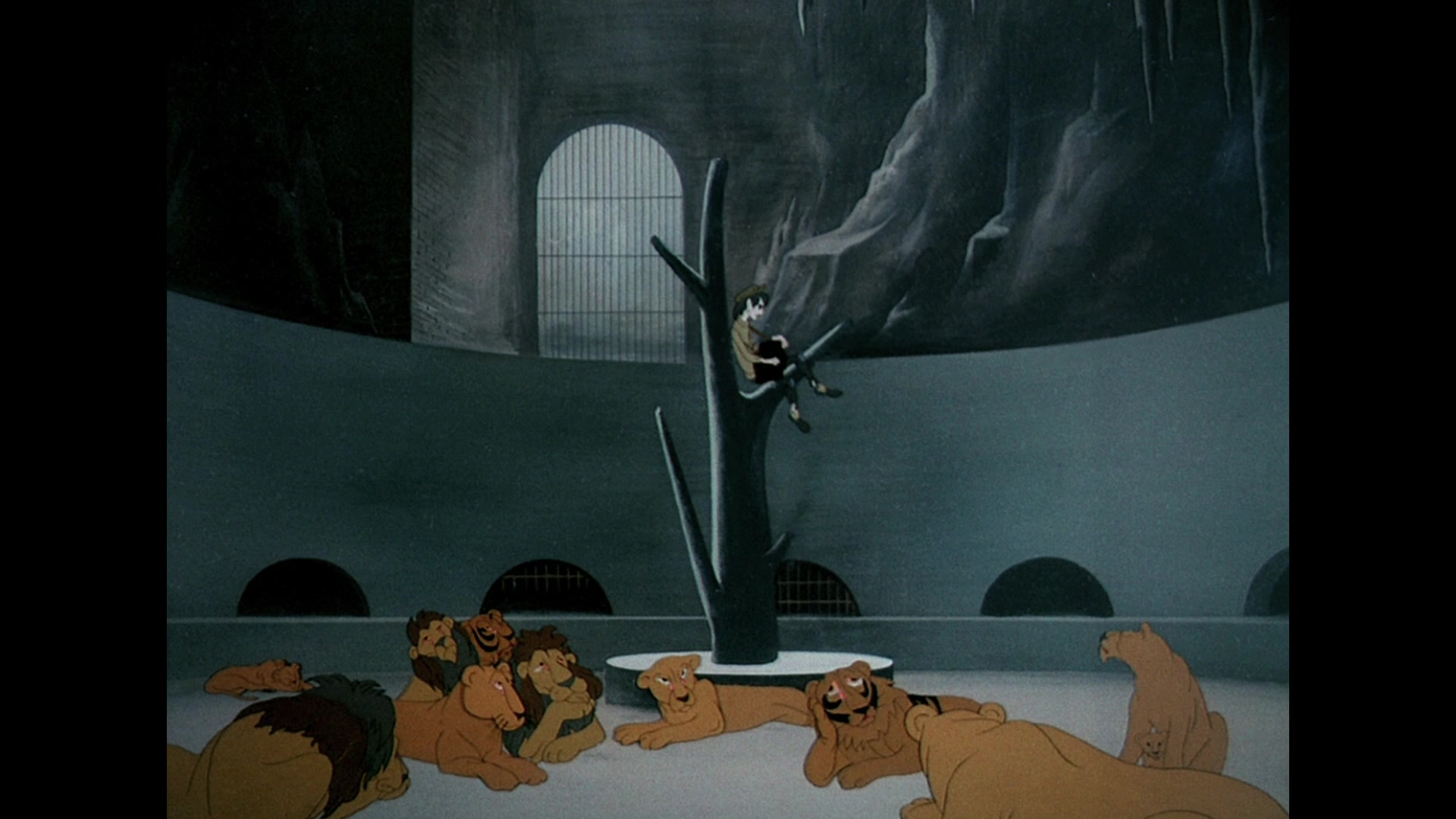
The organ grinder in a dead tree in the lion enclosure

The 1980s version, in addition to removing the sonic references to a busking organ also portrays mechanical organs generally as a neutral technology. The king’s giant robot has quite a lot of space set aside for a fairground organ within it. This organ does play music that could realistically emit from it. It has a large number of tuba-like pipes. These low brass sounds are used to ominous effect and indicate menace.
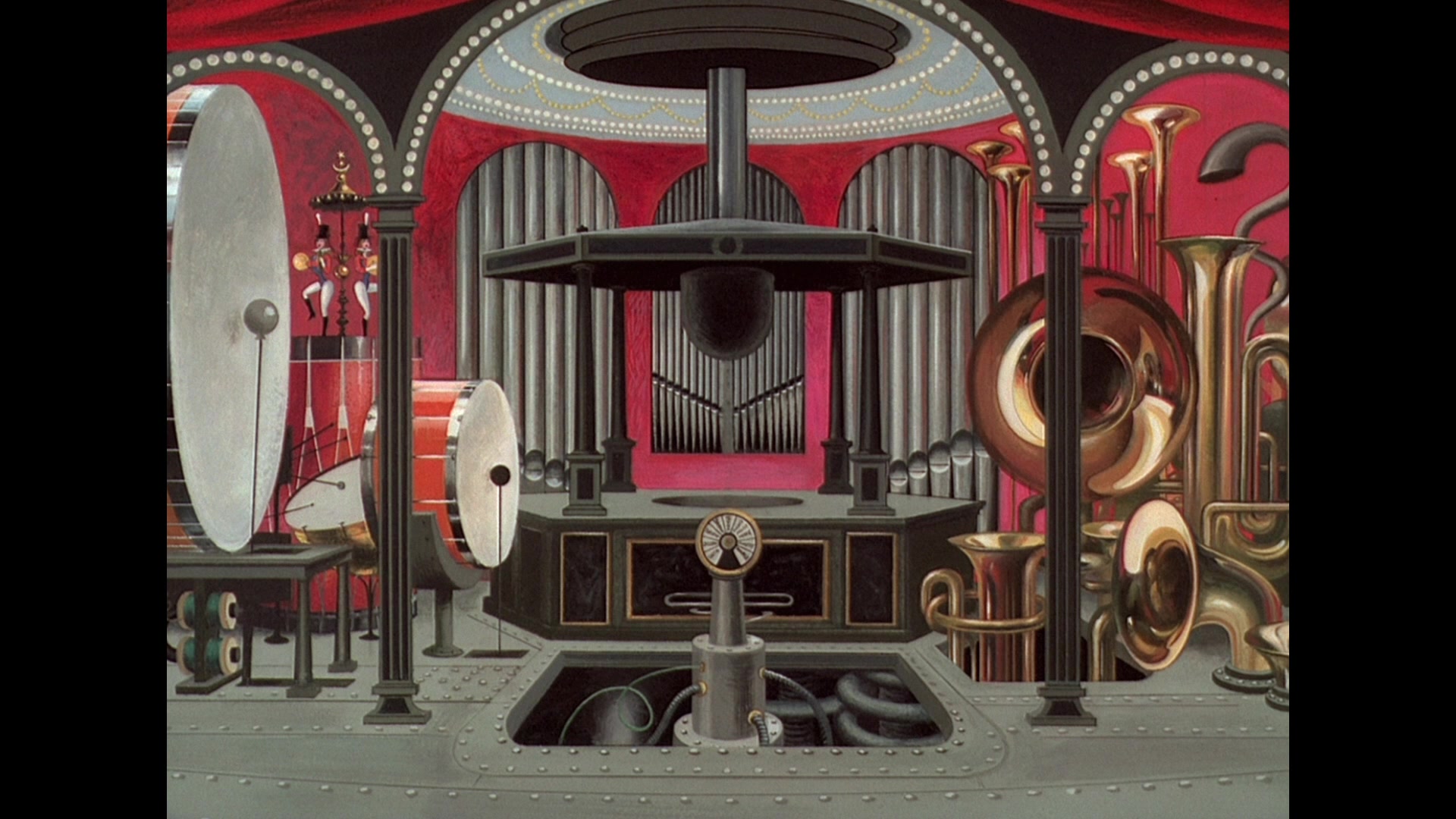
The king's enormous organ
The king’s enormous organ

The epilogues of the two films also differ. Wonderbird ends with the survivors of the regime collapse living in an idyllic camp near the ruins of the urban centre. The 1980 version, has a more satisfying emotional tenor in which the robot has become both disables and autonomous and acts to smash one of the king’s remaining cages. Although this is the right emotional tone, the political messaging is more muddled. The master’s tools do take down the master’s house.

Comparing Brundibar and Le Roi

In the wedding scene of Le Roi, all of the guests are male guards – oddly modelled on Victorian Englishmen. The society is clearly very class stratified, but this is mostly expressed in terms of military command. In that scene, there is also a propaganda agent, taking a pseudo-journalistic role, while also instructing the crowd when to cheer. He seems to be a parody of Soviet reporting. The king’s art museum also has a docent/security guard who ranks below the king’s guard and is abused by them. The guards themselves who are of equal rank appear to behave equally. The proletariat are also apparently equal among themselves.

It’s perhaps not overly useful to compare this fairytale society with actual Nazis, but to do so anyway: The SS’s structure promoted camaraderie and downplayed command structures, so being within it felt relatively flat. However, there was a very clear hierarchy between members and non-members.

By contrast, Brundibar both is and is not a fairytale. It has talking animals, but the organ grinder is grounded in material conditions. As an allegory, his actions both lie within fairytale logic and how children might perceive adult actions regarding rules they do not understand. Unlike Le Roi, only the subaltern is present. The opera has only civilian characters and depicts an extremely unequal society, in which I argued previously, the organ grinder is a middle class between less privileged buskers and patrons. In his paper, The Social Basis of Fascism Sinclair suggests that a more accurate term would be ‘middle strata’, which is ‘preferable because it conveys the idea that included share an intermediate position in the status structure of a society, although they may belong to different classes.’ (p 101) While it would normally defy credibility to imagine any busker as in an intermediate class, we can perhaps justify it here from the fairytale view of children who are definitively below Brundibar, the organ grinder, in the social and class hierarchy.

But what did fascism mean for the middle strata? In 1936, Barnes wrote about the relationship between fascism and the middle classes. He writes, fascist ‘popular electoral campaigning has been directed chiefly to the middle class. It has been most successful in those countries where a disaffected petit bourgeois class is allied in politics with a land-hungry peasantry. Especially in its initial struggle for power and to some extent as a continuing policy, Fascism has looked to these groups for its popular support.’ (p 25) But these groups are not naturally united. Their ‘attempt “to formulate a coherent, workable system is handicapped at the outset by the fact that as a class it possesses the homogeneity neither of the trust bourgeoisie nor of the proletariat. It is a mixture of heterogeneous elements, some in undisguised conflict.” ‘ (p 27) Thus suggesting that fascism’s middle strata are a coalition of groups seeking greater power. The inherent instability turned out to not be a material problem for fascist countries, who in reality organised for the benefit of corporate monopolies. ‘Power once achieved, the forgotten man [of the middle strata] was once again forgotten.’ (p 28) The fascists thus used a disparate and divided group of people who felt some privileges to gain power while actually ignoring their concerns.

In Brundibar, the eponymous organ grinder steals the children’s takings, which he believes are rightfully his. In terms of Eco’s ideas of Ur Fascism, he feels frustration, so he takes action. This speaks to the every day, individual experience of fascism, which is often expressed as conflict between individuals who are empowered or disempowered under the unjust systems. It is not Donald Trump out shooting bystanders, but swarms of ICE agents who are terrorising communities.

If Brundibar is a warning against social hierarchy, and a reminder that in a fascist state, we are surrounded by little dictators, what can Le Roi teach us? Cooksey writes, ‘Begun in the wake of European fascism and the occupation of France, Le roi references totalitarian spatial design and the iconic images of the dictator. By underlining their construction, the film satirizes and subverts the authority claimed by the spectacle of fascist grandeur.’ (p 210) As to the mechanics of this, Cooksey writes, ‘Takicardie’s chief industry is devoted to the mass-reproduction of the King’s image, reduplicated throughout the city in paintings, sculpture, and even topiary. In a symbolically relevant turn, one of the images of the King escapes from a recent portrait, replacing the actual King. In this political allegory, the image of the face becomes the literal controlling master sign, defining everything in the kingdom.’ (p 214) Politically, our heroes are inherently opposed to this, ‘The identity of shepherdess links her with the pastoral, while that of the chimney sweep with the urban. We might recall William Blake’s Songs of Innocence and Experience. Together their love points to an alliance of town and country, broom and crook instead of hammer and sickle.’ (ibid)

As the film progresses and characters are thrown to beasts, ‘The [blind organ grinder], who knows only perpetual darkness, is so inspired [by Mr Bird] that he begins a sad but hopeful song. . .. Moved by this song and Mr. Bird’s oratory, the beasts spare the prisoners and then break out of the den, forcing their way out of the subterranean city and upward into the palace, where they disrupt the King’s forced wedding to the shepherdess, primal forces emerging from the lower depths (the id), to disrupt and shatter the superego.’ (p 216) Thus emphasising the role of the arts as a force for resistance. Indeed, Duggan writes, ‘The film valorizes artistic and political freedom.’ (p 75)

A lion enjoying organ music

However, as the king’s second, larger organ also suggests, Cookes notes the ‘underlying theme of fascist spectacle and the connection between the regime of signs and the despotic.’ (p 216) Art can be used for good or for evil. In the world of Takicardie, this is most often expressed via architecture, ‘Here the city and its public buildings are conceived as works of art that establish social strata and ceremonial spaces. With its monumental buildings, its formal manipulation of heights, creating hierarchies between the public and the domestic.’ (p 217) In Brundibar this is primarily expressed via social relationships, but the fairytale king of Takicardie has greater scope to create material conditions. The style of the king’s city ‘was the style favored by the totalitarian regimes of the 1930’s.’ (ibid)

As to the music, the timbres of the king’s organ reflect the sheer size of it and do reflect an assertion of power. However, the styles and content does not otherwise seem to link to the allegory. Indeed, the affordances of actual organs are not considered by 1980.

The film, especially the latter version, suggests no particular action but merely affirms that fascism is bad and freedom is good. The absence of a call to action in children’s media is certainly a reflection of the safety in which it was made.

Works Cited

Barnes, J. (1936). The Social Basis of Fascism. Pacific Affairs9:24.

Cooksey, T.L. (2019). Pataphysical Assemblages: Fascist Spectacle in Paul Grimault’s Le roi et l’oiseau. The Comparatist43:209–227.

The Curious Adventures of Mr. Wonderbir (1952). Clarge Distributors. 63 minutes.

Duggan, A.E. (2015). The fairy-tale film in France: Postwar reimaginings. In: Fairy-Tale Films Beyond Disney. Routledge, pp. 64–79.

Eco, U. (1995). Ur-fascism. The New York review of books22:12–15.

Hans Krása (1938). Brundibár. [Opera].

Le roi et l’oiseau (1980). 83 minutes.

Sinclair, P.R. (1976). Fascism and Crisis in Capitalist Society. New German Critique:87.

Toltz, J. (2004). Music: An Active Tool of Deception?: The Case of’Brundibar’in Terezin. Context: Journal of Music Research:43–50.

Wikipedia (2026). The King and the Mockingbird. Wikipedia [Online]. Available at: https://en.wikipedia.org/w/index.php?title=The_King_and_the_Mockingbird&oldid=1333784331 [Accessed: 21 January 2026].
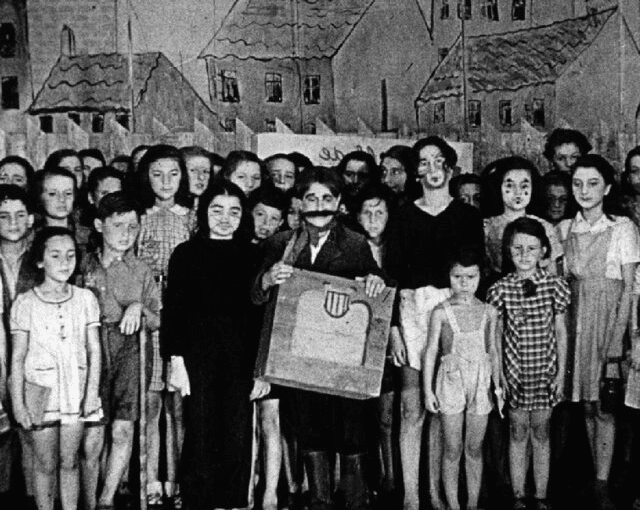
Brundibar and Organs

If the Italian stereotype was gone by the end of WW1, then what can we say about an opera written in WW2?

Toltz has the answers to my questions.

‘On 7 July 1943, Rudolf (Rudi) Freudenfeld . . . arrived in Terezín with his allotted fifty kilograms of luggage. Smuggled within was the piano score of Brundibár. In the camp, the score was re-orchestrated by the composer for the various instrumentalists who were available. Rehearsals were held in secret. The set, to Zelenka’s design, was constructed out of stolen wood; choreography was undertaken by Kamila Rosenbaum, a prominent modern dance exponent in Vienna prior to her transportation; and the premiere of the Terezín version took place on 23 September 1943, in the hall of the Magdeburg barracks. All in all, Brundibár was performed fifty-five times in Terezín up to the end of 1944, making it the most popular and most frequently performed work in the camp.’ (p 45)

Camp survivors, ‘Rind and Weissberger share an explicit agenda in exploring and commemorating Brundibár: exploring through personal collecting of recordings and information, commemorating it as speakers at performances, and advocating future performances of the work. They both hold the determined belief that the meaning of Brundibár, the simple message advocating an eventual triumph of good over evil, makes it all the more worthy for performance as a message of tolerance, one of the reasons they invest so much emotionally in the work. Both Rind and Weissberger also believe that performing Brundibár in a modern context commemorates the lives of the children who did not return from Auschwitz.’ (p 47)

And what of the use of an organ grinder as allegory? ‘Precise cultural understanding of the work is exceptionally important to Rind and, as well as pointing out the inadequacies of the current English translation, he also brings forth hidden meanings in the narrative. The character of Brundibár is an organ-grinder in the plot, and the cultural understanding of the role of organ-grinders in the post-World War I Republic of Czechoslovakia is crucial to Rind’s reading of the work. Organ-grinders were often wounded soldiers granted license to busk in their own particular area or canton and, when the children begin to busk on Brundibár’s turf, they transgress this adult rule, without being aware of it, and thus earn the ire of all the adults. Without this cultural understanding, the character of Brundibár could quite easily transform into a typical evil (outsider) caricature from fairytale or folklore. Rind’s contextualisation is therefore crucial in informing an accurate cultural reading of the story.’ (p 48)

Zooming out to an alternative reading, which I recognise is a fraught thing to do with a text with this history: The character of Brundibar, called a “dictator” in the English translation, is kind of a middle class figure. He was injured in service of the capitalist state and the military industrial complex, in such a way that made him “unfit” for further productive work. He has been granted a busking monopoly by the system, living in extreme precarity.

When children, more vulnerable than him, are also left without options other than busking, Brundibar fights to maintain the small amount of privilege he has been granted, acting the part of ‘dictator’ rather than siding with others exploited.

Brundibar therefore acts as a buffer between starving children and the adults with money who walk past them both. Therefore, the classes above the busking class are never actually threatened. All the action takes place in between the most vulnerable people in society. True revolution is never on the table, despite the revolutionary zeal of the youth.

The Shoah was a specific tragedy and one should avoid universalising, but a particular allegory in a particular play can possibly carry more baggage. Most productions on YouTube do seem to particularise it. Many have the children in it dressed in camp uniforms, to further tie it to the Shoah, even if this, itself is ahistorical. This particular camp was a showpiece for Nazi propaganda and, in documentary footage, the abductees did not wear uniforms. A well-produced Italian version transplants the set to Auschwitz.

I also found a British school production that seemingly made no reference to the play’s context and performed it as an opera with value in its own right as an artwork.

The moral of the play is defeating dictators and oppression through solidarity. This message is still timely and for this reason, I would argue that it’s valid to treat this as a living work, reinterpreted, restaged and sometimes recontextualised. The original context should never be erased or ignored, but part of “never again” does mean being vigilant now. Perhaps the in-between status of the Brundibar character reflects that the defeat of fascism is not just deposing one man, but an entire system and those who uphold it. That the “ordered liberty” some seek to impose makes everyone a dictator to those below them. All of these dictatorships must be overthrown.

Works Cited

Hans Krása (1938). Brundibár. [Opera].

Toltz, J. (2004). Music: An Active Tool of Deception?: The Case of’Brundibar’in Terezin. Context: Journal of Music Research:43–50.

Organ grinding literature review

Following on from the start of exploration, what’s the deal with Brundibar?? My mental image of an organ grinder is a man with a monkey. He is standing in Manhattan. It is near the year 1900. He is an immigrant.

“Surely some of these organ grinders were Jewish?” I said to my spouse.

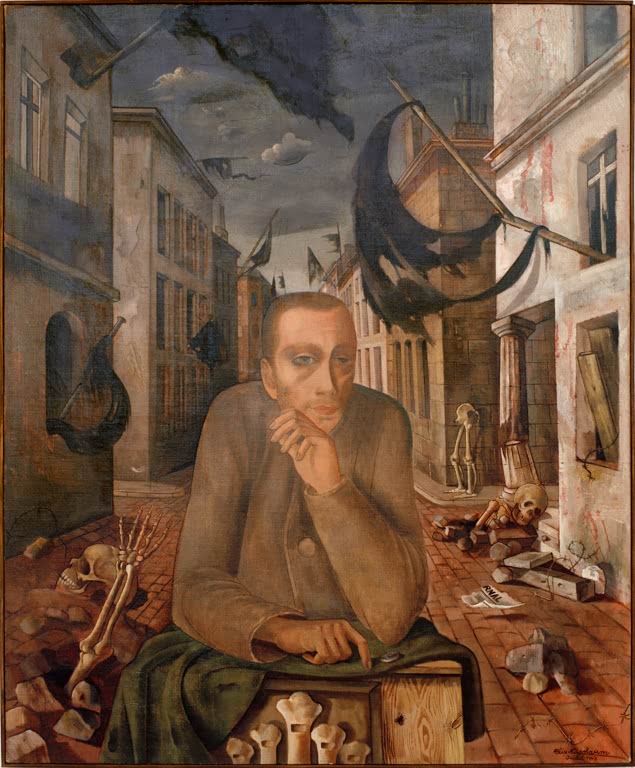
She started looking and found a portrait of an organ grinder, painted by a Jew hiding in Belgium during the war.

Nussbaum, Felix,
1904 – murdered in Auschwitz 1944,
German painter.

“Orgelmann” (Organ grinder), 1943.

Oil on canvas, 102 × 83 cm.
Osnabrück, Kulturgeschichtliches Museum.

Nussbaum painted organ grinders multiple times. See https://berlinischegalerie.de/en/digital/provenienzen-kunstwerke-wandern/nussbaum-leierkastenmann/ and https://keesvanhage.wordpress.com/4-18/, the latter of which comes with an essay. It states, “The organ grinder with his mobile instrument is a typical Berlin figure and not only the symbol for the artist living in poverty, but also for the artist as a craftsman, who has to work hard, turning the organ crank.”

It’s unclear to me whether they mean a character found in Berlin or a character that appears often in Nussbaum’s work during his Berlin period.

So were some organ grinders Jews? Not typically. Most of them were Italian and obviously there have been Jews in Italy since the Roman era, but stereotypically, this was a job for Catholics.

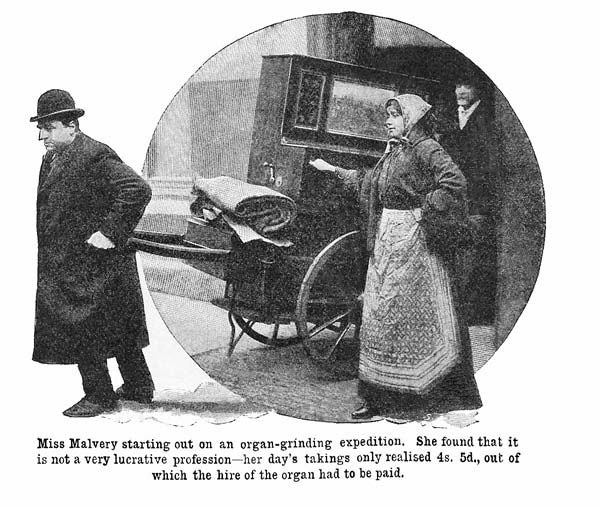
According to Walkowitz: Edwardian author, Olive Christian Malvery put Jews and organ grinders into distinct categories when writing for ‘Pearsons’ in 1904. As an investigative journalist, she cosplayed at several types of poor person living near the Thames, including as an organ grinder, for which she pretended to be Italian.

However, she also separately wrote about Jews from a distance, as aliens whose migration should be controlled and reduced.

Therefore, we can be reasonably certain that organ grinding, which does carry ethnic baggage in Malvery’s poverty drag, was not associated with Jewishness. Indeed, Malvery put Jews and (Italian) organ grinders in direct binary opposition.

‘Unable to gain entrance to the parts of Russia from which Jews were fleeing pogroms, she focuses attention instead on the local conditions of Southern Italians whose primitive conditions are meant to stand in for the Jews. The “condition” of “Russian Jews in their own homes,” she assures her readers, “is quite on a par with the lowest type of Italian emigrant’. (p 25)

However, she goes on to say that Italians willingly submit to fumigation, but Jews “really believe that cleanliness is unwholesome and washing a dangerous adventure.” (p 26)

‘Although Malvery tends to link Jews and Italians on the continent, she emphatically distinguishes between these two immigrant groups when they appear on English soil. Italians may be degraded in their native country, but, once in England, they readily assimilate themselves to local conditions. Malvery expresses “warm feelings” toward “the children of the sunny south,” who, as organ grinders and street entertainers in Lodnon, bring music to the poor and pose no economic threat to “native” English workers.’ (ibid)

‘Unlike Italians, Jews cannot be integrated into the body politic of the English nation; they remain a parasitic class of foreigners, with no real homeland.’ (p 28)

The organ she ground, by the way was quite large. Pulled by a man on a cart, the operated the handle.

The ethnic stereotypes are not solely an English phenomenon. Organ grinding is also associated with Italians in Massachusetts in 1871.

‘ “What work could be harder” they ask, “than carrying this organ all day?” ‘ (Russo p 49)

‘One [Italian economic migrant] is a coal-heaver in winter and an organ-grinding “troubadour” in summer: the opposition of the paleotechnic drudge and the carefree gypsy [sic] singer of love songs corresponds to the seasons . His “lazy,” “soft-eyed” boy, who collects money with his tambourine . . .’ (ibid)

‘Despite having been cheated of his wages and left destitute in South America, the “swarthiest” organ-grinder possesses “that lightness of temper which seems proper to most northern Italians, whereas those from the south are usually dark-mooded, sad-faced men”. Stack observes that “Brahmins [upper class Bostonians] distinguished between Northern and Southern Italians from the very beginning of the Southern Italian invasion of Boston in the 1880s. Consequently, Brahmins viewed those Italians from Northern Italy as a part of Western civilization.” According to the Brahmins, the “Germanic blood” and “artistic achievements” of the northern Italians “sharply distinguished them from the ignorant peasants of Southern Italy.” (p 51)

‘ “The poorer classes of foreigners in any city are led by similarity of language and occupations to gather into neighborhoods according to their nationality, and the Italians are especially clannish. The fruit-venders and organ-grinders form separate colonies, each distinguished by the peculiarities incident to the calling of its inhabitants,” ‘ (p 64)

But what was happening in London? Again with the binary oppositions.

‘ Unlike Jewish or Irish objects of disdain, Italians came from the land of the Roman Empire, of Verdi, and of the cultural glories of the Grand Tour. Their struggles for national independence in the mid-nineteenth century gave them added glamour—and yet when on the streets of London they also aroused fear and loathing in a particularly complex and venomous way, as this essay will show.’ (McAllister p 286)

Ok, so, Victorian organ grinder discourse:

Organ grinders in London and the Eastern US were stereotypically Italian. The social position of Italian migrants in that era was complicated partly because of the association of Italy with the Grand Tour. (This was a sort of arts holiday still practised by young americans going to the art galleries of Europe’s capital cities via a Eurail pass, only then it was a tour of Italy and English people also did it.) Thus Italians and Jews were placed in a good migrant / bad migrant binary opposition, although both were bad for being migrants.

To say more definitively, we must learn what the position of organ grinders was in Czechoslovakia during WW2, but I think it’s likely that the reason Brundibar uses an organ grinder as the Hitler-analogue antagonist is more about the properties of the organ: it was loud, it was a capital investment, it likely didn’t (and couldn’t) play Jewish music. It was therefore something that would drown out children, that they couldn’t afford, and that they could not accompany as it didn’t play their tunes.

Was the Victorian discourse even still valid in WW2, and in another country halfway across Europe? In either case, what impact does this have on a project actually in London? How do these historic discourses speak to our modern time?

McAllister’s paper does suggest some of the Victorian era conflicts are kind of timeless in their shape, if not their particulars. ‘The fragility of masculinity and social status [of middle class Victorian men] was such that it had to be remade in almost every context, from one’s own hearth to street confrontations. In such a situation, uncertainty was raised about boundaries of all kinds, and therefore much of the mid-nineteenth-century discourse about the organ-grinders explores liminal spaces—or that contested boundary between the hard-won home space and uncontrollable outside and other spaces (depicted in cartoons as pavement). In infringing upon this space, the Italians, by their very national positioning, were made to serve as a repository for negative and feared qualities. For example, their very links with the world of music which could confer social and cultural capital, as demonstrated by opera composers, conductors, and singers, posited alternative values to those of the solidly—or stolidly—middle-class John Bull. This is of particular significance with the Victorian soundscape, where notions of aurality and the value and acceptability of public sounds were open to negotiation in a shifting cultural climate.’ (p 292)

She goes on to discuss the social meanings of ‘noise’.

The social meaning of organs in that era was not what I expected. Honestly, I would have guessed that organs were exciting symbols of modern technology. Clockwork, punchcards, factory technologies and the industrial revolution were all there! But I guess in the 1980s “ghetto blasters” were also exciting new portable forms of newly accessible technology.

Previously, I called street organs ‘protestant*’. But they had a different cultural position when they were hotly debated – Italians generally were not protestants. The organs themselves were different. Malvery’s organ was huge. BOGA** has said that many Victorian organs were reed organs, (like a harmonium or accordion) whereas people now tend to use pipes. I also think street organs now are more often stereotyped as Dutch. So how did these changes come about. And *when* and *why* was the current 20 note scale picked?

I should have started with wikipedia: https://en.wikipedia.org/wiki/Street_organ

‘In New York City, the massive influx of Italian immigrants led to a situation where, by 1880, nearly one in 20 Italian men in certain areas were organ grinders.’

‘Charles Babbage was a particularly virulent enemy of the organ grinders. He would chase them around town, complain to authorities about their noisy presence, and forever ask the police to arrest them.[10] The violinist Yehudi Menuhin, on the other hand, was photographed in 1949 handing an organ-grinder in Berlin some change with the caption: “we musicians must stick together”.’ (ibid)

Current organ grinders ‘may perform at “organ rallies” (such as the “MEMUSI” event in Vienna), where many enthusiasts would assemble and entertain on the streets.’ (ibid)

But back to McAllister, ‘Mayhew quotes an organ-grinder, “you must have some opera tunes for the gentlemen, and some for the poor people, and they like the dancing tune.” We are then given slightly more detail about his current repertoire, “Two are from opera, one is a song, one a waltz, one is a hornpipe, one is polka, and the other two is dancing tunes. One is from I Lombardi of Verdi.” Picker also uses Verdi in his description of the grinders’ repertoire as a continuum “from the prison song in Il Trovatore to ‘Rule Britannia’”. Yet despite such links with high-status opera, these musicians were damned—their low status as performers was further undermined by their ascribed embodiment of dirt, poverty, and animality, and they represented the lowest possible strand of society. Thus, class concerns were embedded in the public reception of their music, whether opera or “dancing tunes.”’ (p 298)

Some of this repertoire lives on. At the Amersham Fair Organ Museum, I heard Rule Britainia on a much larger organ than even the one played by Malvery.

‘But of course Italians inhabited a particularly contested cultural area. They were dashing revolutionaries, winning their liberty; they were the inheritors of Rome, Dante, and Michelangelo; they were sensuous, exciting, musical, handsome, and therefore represented a possible threat to the self-esteem of an Englishman. So other strands of discourse about them were necessary. The bourgeoisie could constitute Italy as a place of peasants, whose much-vaunted cultural superiority stood revealed as a sham—a degenerate animal-like race who used street music as a weapon for blackmail and legitimized crime. This is the arena in which the war of the organ-grinders and Punch was played out.’ (p 309)

‘And then they were rehabilitated. The symbolic victory of The Street Music Act allowing Punch to quit the field with honor and the changing political and social context provided less dramatic images of Italians and they clearly presented less of a challenge. Once Italians had accepted England’s superiority, symbolized by their adoption of English-pattern constitutional monarchy in the 1860s, they could be safely patronized, and even adopted as honorary Englishmen, like Garibaldi. Italians faded from public view somewhat after the dramatic events of the Risorgimento, losing much of their exotic signification. Punch, once it had won a small but significant victory, moved to another, existing, target, the un-musical Irish, treating them in a similar, if less complex, manner. But the uniting of music and animality in these images from Punch provides several interesting insights into the processes by which the rich, and potentially destabilizing, possibilities of Italians gave rise to a xenophobic episode in English cultural history.’ (ibid)

Circling back back around to Malvery, she was a big deal in the Edwardian age and she was not the only woman of the era to dress up in this way! Voracheck writes about organ grinder drag and the position of grinders at the time, ‘The organ-grinder undermined the demarcation between private and public space with his music, a sound which could not be contained in the street. Carried into the homes of those who did not want to hear it, his music and his foreignness encroached on English domains. Moreover, organ-grinders travelled from East End slums to wealthy West End neighborhoods on a daily basis, freely traversing class-coded terrain.’ (p 409-410)

‘John Picker observes that the antagonism of the 1850s and 1860s was replaced in the 1880s and 1890s by nostalgia for street music. In the intervening years, protests against organ-grinders and street music diminished due to a middle-class exodus to the suburbs of London and because
public attention shifted . . ..

‘However, Italian organ-grinders did not become “quaint curiosities,” as Picker argues, but actually increased two and a half times between 1861 and 1901. This growth may have been due to an upsurge in the number of female Italian immigrants in the second half of the century, many of whom took up organ-grinding. Moreover, the last two decades of the nineteenth century saw an influx of Jewish immigrants to England, and according to historian Lucio Sponza, anxiety about this other “alien invasion” led to renewed agitation against organ-grinders and attempts to legislate against street music.’ (p 410)

‘The fact that female reporters’ articles are supported with visual documentation indicates that the authority for their investigations lies in their embodied experience of the lives of organ-grinders.’ (p 425)

‘ . . . by the end of the first decade of the twentieth century, organ-grinding seems to have lost its association with Italians. When in 1911 Frank A. Morgan and Harry G. Hopkins recounted for the Pall Mall Magazine their three-day experience of playing a barrel-organ on the streets of London to raise money for charity, Italians and the Italian colony received nary a mention.’ (p 429)

Works cited

MC ALLISTER, A. Punch’s Campaign against Italian Organ-Grinders, 1854–1864. Fear, Loathing, and Victorian Xenophobia:286.

Russo, J.P. (1994). From Italophilia to Italophobia: Representations of Italian Americans in the Early Gilded Age. Differentia: Review of Italian Thought6:7.

Vorachek, L. (2012). Playing Italian: cross-cultural dress and investigative journalism at the fin de siecle. Victorian Periodicals Review45:406–435.

Walkowitz, J.R. (1998). The Indian Woman, the Flower Girl, and the Jew: Photojournalism in Edwardian London. Victorian Studies42:3–46.