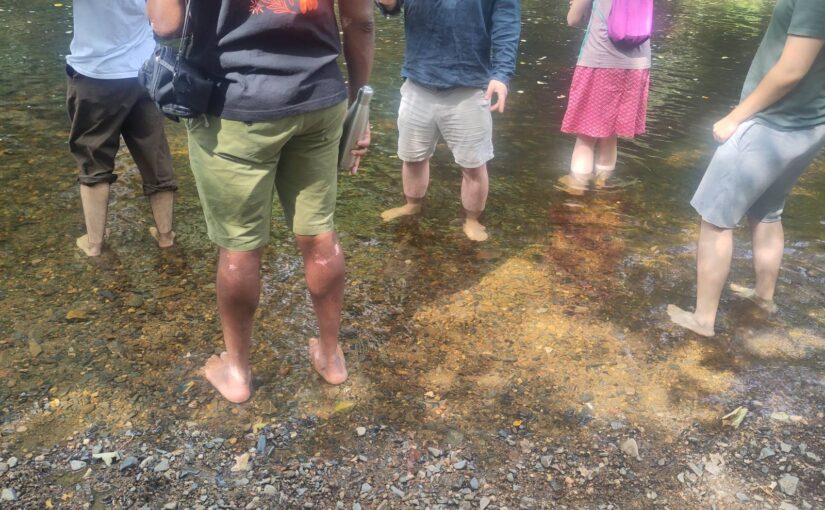
These are my unstructured Error Camp thoughts, which are a few days out. My Error Camp visit was in a context, wherein I was struggling to finish a large project beforehand and working long hours and then set off for a long trip the day after I got home from camp. I’m writing these thoughts on a boat between Germany and Lithuania.
Error Camp and some other computer music gatherings (but, sadly not all) feel like building a temporary utopia. In some ways, it reminds me of my Masters Degree, where the most important conversations were in the hallways and around seminar tables, always right before the class began. The closer we got to the cutoff, the more it felt we were on the verge of a breakthrough. I spent years thinking about how to prolong that liminal moment. Our temporary communities are liminal moments in that vein.
But the liminal moments of EC are often non-verbal. It’s a shared activity. I wish we could stretch it out like a degree programme, but it’s also been intimately tied to the weather and climate. Britain is very seasonal and Error Camp seems structured around summer and festivals.
There was less dancing than I expected – I somehow missed the maypole. But there was more interaction with sheep. I may prefer cabin bunks to camping in a tent, but that’s a weak preference. I wish the cycle commute was less arduous or I was better prepared, which I could have been. It was good to be in a space and feel fully present. I appreciate the diversity of participants in skill and experience. I don’t live code very often and sometimes wonder whether I belong, but didn’t experience that this time. I was also happy to hear a clarinet and other instruments. The overlap between what’s included and my own practices seems to be growing, which I like for selfish reasons and also because I tend to favour wider focuses more generally.
The idea to make zines was brilliant. My family used to subscribe to many BASIC magazines, including one called Family Computing, so this was doubly nostalgic for me. I want to take this out to the permacomputing community. The weird language show and tell was also brilliant. I used to feel intimidated that so many live coders seemed to eventually write their own live coding language. This was a mixture of created and found, which felt much more approachable. (Also, it turns out that a small live coding language can be easier to write than I feared.)
There was a trend of restorative workshops – yoga, meditation, Deep Listening, harmonic singing. All of them rooted in corporeality. This feels both needed for our own well-being and like a direct and important challenge to California Ideology 1ideas like the ‘Declaration of the Independence of Cyberspace’ which pretends bodies do not exist in order to erase recognitions of embodied conflicts, like racism or conflict minerals in our computers. We are not brains floating jars. Our equipment has a real human cost, which requires some mindfulness at the very least. We are humans. Our music is human. We have bodies with needs and wants.
I have hopes – that we can take the spirit of sharing and building out into the world and grow a movement of digital sovereignty. I have fears of replicating the libertarian mistakes of past decades and of art washing. Art and activism should be able to operate in separate spheres, but we came to this camp at a moment of profound crisis. Our rights are in peril. The world is heating. At the end of June, a friend of mine died of heatstroke. He is the first person I know of to die of climate change, but he won’t be the last.2
And so, I want us to be part of the solution. I want our values to include this. We have good points about social justice, but vulnerability to heat is so closely tied to injustice, that it is not enough to say that we won’t replicate unjust hierarchy – we have to work to mitigate the material conditions of structural violence.3 Because of our relationship with tech, this is, to my mind, within the scope of things we should be working on and I see possibilities for valuable interventions, which have gotten positive responses on Mastodon.
Also, being in a tech/art space that is mostly free of microaggressions is probably why these events feel utopic for me. There are ways in which the world is getting better because we are making it better.
I feel energised and have perhaps too many ideas to carry forward: a busking organ tour via bicycle; a series of workshops with performances in the old Open Lab model, but with a focus on hardware sustainability; algorave busking flashmobs; more zines; and what about hardware turing machines controlling acoustic instruments?
- I hate that this is named after the place I came from. My grandparents certainly would not have recognised the ideas, dreamed up by people who came from other places. ↩︎
- Can I take a moment here to ask people reading this to become aware of the signs of heatstroke? I won’t include them here, but please do look them up. It is a serious risk for people of every age group and state of health. ↩︎
- This is a type of preventable harm caused by institutional neglect or hostility. Cyclists getting hit because of badly designed junctions, people in England who have malnutrition, and people who get heatstroke are all examples of structural violence. ↩︎
