Sustainability

Someone on Diaspora asked me: if I only use recorded sounds once, how does this effect sustainability of my music?
This is an interesting question! While the sounds themselves are not recycled, this actually does effect my disk space usage. Once a piece is done, its done and I don’t need the source sounds any more, so I have no need to keep them around. This means that at the end of creating a minute of noise, I have, usually, an uncompressed file and a compressed Mp3 (plus whatever file format the commissioner wants for themselves). A minute of AIFF or WAV runs up to 11 MB and the MP3 is around 1MB, so this really takes up very little hard drive space. (Indeed, the Mp3 could fit on a floppy disk!!)

There are other concerns in sustainability however, one of the most important is e-waste. Every time you get rid of an old computer, it needs to be disposed of without causing pollution. This makes disposal a challenge. Indeed, getting a new laptop involves a fair amount of pollution and may also include conflict minerals. I’d say upgrading hardware is a greater sustainability issue than hard drive space might be. How does this interact with my music?

  • Digital Music – This has the greatest potential for e-waste, however, my laptop is already 4 years old and I have no plans to upgrade it, because it is fast enough to do what I want. I write my own programs in SuperCollider to digital audio. When I started doing this, more than a decade ago, I had to be smart about efficiency, so I could get everything to run in real time without maxing out my processor. I really have never run into this issue at all with my current laptop – I feel like the upgrade cycle is now more driven by graphics. I run Ubuntu Studio, which also specifically supports older laptops. Should this laptop die, I would probably get a used one. Indeed, I’d look for the very same one I have now.
  • Acoustic – I mentioned using sounds from all kinds of various locations as possibilities in acoustic pieces. However, these were gathered while I was already in the area. I try to avoid flying as much as possible. Since I don’t re-use sounds, putting together an acoustic piece frees up space on my hard drive.
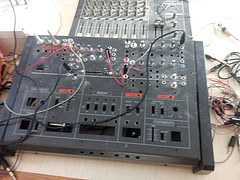
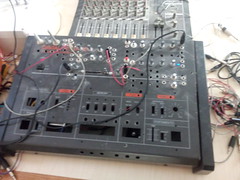
  • Analogue – when I bought my synthesiser, 15 years ago, I also bought a computer at the same time. I still use the synthesiser all the time. Analogue hardware doesn’t go obsolete and doesn’t require upgrading. When I get new modules, it’s to add new functionality, not to replace what I’ve already got. For people who want to make electronic music, analogue gear has a higher upfront cost, but outlasts digital. I expect my synth is less than halfway through it’s usable life. Planned obsolescence and the e-waste created by that is just not an issue.

Commissions are ecologically friendly and make great gifts! Digital-download-only commissions are a perfect gift for for Green friends and family who want to avoid clutter. Delivery is guaranteed in time for Hanukkah or Christmas. Order now! The introductory price of £5 will only last until Thursday.

Do you love noise music? Do you have fashion? Drop me an email if you’d like your image to be in forthcoming posts about noise and fashion

Glitching sounds

Today, I went to the Loud Tate event. My friend Antonio Roberts was presenting some work. Also, there were workshops on glitch and modular synthesis.
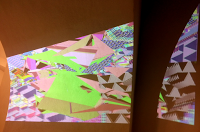
Antonio’s piece was a projection of ever changing glitch, which my mobile phone camera failed to adequately capture. It was being shown on the underside of an arch in a round stairwell. Tate Britain is really full of art, so it must be hard to accomodate one day installations.

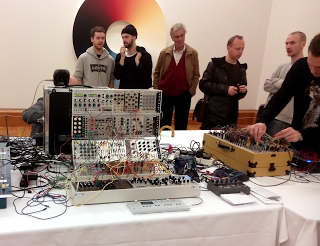
The synthesisers were set up in the middle of a gallery. Three guys with cool modular systems were buried in their wires, twisting knobs and making beats. I’m not totally sure how educational it was, but I did get to look over their shoulders. Modules have changed a lot since I got my MOTM system in 1998-2000. There are a lot of cool new ideas and, I suspect, new ways of labelling the old ideas, which make it slightly confusing for a fogey like myself. I commented to somebody that synthesisers had changed a lot in the last 14 years and, anyway, it turns out this event was actually meant for people under 25.
I suspect that at least one of the guys with the synths was playing with the analog modular group that I had tried to take my dad to see, the night that he developed his heart problems. I kind of wanted to ask if they were the same guys, but I thought the conversation might get awkward…
I do have one new module that I’ve yet to fully explore, and I’m pondering adding a few others to get caught up with these modern times. I’m looking forward to using my new module in a commission. It models orbital dynamics of planets in some way. I’m hoping it can be made to undulate, which is a customer request I’ve just gotten.
The visual glitchers were also having a meeting, so I went there to see Antonio. Unfortunately, I missed their presentations, but I did catch Antonio giving a quick tutorial in graphic glitching. He saved an image as a bitmap and then opened it in Audacity as a u-law file. He added some phasing and echo effects and then re-saved it as a bmp. It did interesting things to the image. What I want to experiment with is going the other way. This would likely entail:

  1. Convert an audio file to ulaw format.
  2. Save that file as a .bmp
  3. Open the .bmp in an image editor, such as GIMP
  4. Apply effects to the image, such as reversing it, colour correction, try drawing – I need to play around on this step to see what would happen
  5. Open the bmp in audacity. If it sounds good, convert it back to a WAV or AIFF.

I’m going to try this out when I get a moment. Right now all my commissions are all analogue, so this would be a good experiment for a digital commission, when one of those arrives. I will report back on how it worked in practice.
Tomorrow is an ‘informal meet and greet’ in London for analogue synth users. I’m going to bring my new module – and a screw driver. The mounting rails on it are super fiddly and I cannot get the thing to screw in without cross-threading it. It’s become too frustrating, so I put it aside and hopefully somebody with a steadier hand and more patience can help out.
Your commissions are fun to research and fun to make. They make great gifts. Order now and delivery is guaranteed in time for Christmas or Hanukkah. Act now to get the sale price of just £5 for one piece – there are only two left at that price point!

Do you love noise music? Do you have fashion? Drop me an email if you’d like your image to be in forthcoming posts about noise and fashion

Making a Connection

And the most difficult of Etsy’s points for marketing my shop:

  • They need a connection. In a screaming sea of marketing messages, they need to see that you’re a kind and interesting human being, and therefore worth listening to.
[Puppy. Click through for album of puppy images]

I’ve just taken a break from playing with my new puppy to try to deal with this stipulation of sincerity-on-demand. Well, half taken a break. My kitchen, bathroom and living room are all being repainted at the moment, so the house is extremely chaotic and there’s stuff everywhere. The 13 week old puppy is very curious about exploring, and very into exploring with his teeth, so I have to see where he’s gotten off to and make sure that the chewing I hear is his rope toy and not a power cable. I did catch him tasting the plug for my synthesiser last night. We have 220 volt power in the UK, so should he actually chew through a cable, that would be very bad news.
Last night he also got himself tangled in my patch cords, which is suboptimal and caused my audio interface to tumble, but fortunately, I caught it before it hit the ground. This is extremely poor timing on the painting, since the puppy’s vaccinations have not yet taken effect. I can’t just go tire him out in the dog park. He can run around the house or the smallish back garden (where he tries desperately to eat every ornamental plant in it). A relatively puppy proof living room with a kong toy is fine, but the bedrooms are less so. He also wants to show off his newly acquired ability to run up and down stairs. Anyway, it’s good I’m only trying to write things a minute long, because sometimes it seems like he’s interrupting me every 30 seconds, by racing past with my housemate’s underwear in his mouth or sneaking down to the rooms that are being painted. (note to self: buy a baby gate). (I could lock him in my room, but then he’d be eating my underwear. And seriously, if this paragraph seems scattered, it’s been interrupted 4 times. I know he needs better boundaries etc, but the painting is making it difficult.)
Anyway, back to the point- I’m not sure I agree with the point, actually. Milton Babbitt was well known both for his amazing compositions and his anti-listener screed, ‘Who Cares if you Listen‘. Even Lou Harrison, a benevolent and Santa Claus like figure who I had the great pleasure of meeting and speaking Esperanto with, could be a wee bit of a jerk sometimes. He only thought music was worth his time if he agreed with the tuning system and was contemptuous of composers who used other systems, telling them that their 5th was two cents out of tune. On a musical level, I don’t think it really matters if composers are kind or are good conversationalists.The interestingness of their music matters a great deal.
I don’t think music is a special case in this. A few Christmases ago, I got my sister in law a very nice mug off of Etsy that has owls on it. I did it because I like getting something handmade, because it seems more special and because she loves owls. I communicated briefly with the artist and he was polite and prompt, but I just don’t know about the rest of this. Maybe other people feel differently? Leave a comment if you have a thought on artist personalities.
Whether or not I’m worth listening to, however, is easy to decide. My past commissions are available for your perusal, so you can make up your own mind on this. I’ve got two more underway at the moment! The music commissions are all handmade, and one of a kind. They make a very special gift. Order now and delivery is guaranteed in time for Christmas or Hanukkah. Act now to get the sale price of just £5 for one piece – there are only two left at that price point!

Music comissioning is back!

Folks, I’m offering up to 30 commissions this November of 1 minute long noise music pieces. You as the commissioner get to name the piece. Your role as titler and commissioner will be mentioned in the program notes. If you commission a piece as a gift, or in honour of another person or of an event, the person and/or event will also be mentioned in the program notes. A new piece of music will be created, just for you! Within a week, you will get a copy of the piece emailed to you in the audio format of your choice (MP3, AIFF, WAV, Apple Lossless, AAC) and have one week in which to come up with a title (I reserve the right to nix titles that I deem offensive). I retain copyright, but the piece will be released under a Creative Commons Share Music License, so you (and the honoree) can share the piece with friends via CD or the internet.
As a special feature for this burst of commissions, you can optionally specify if you want your piece to be acoustic, analogue or digital. Also, optionally, let me know if you might use the piece as a ringtone to ensure it gets composed to sound good and loud coming from a mobile phone. All commissions will be delivered in time for Christmas or Hanukkah.
The introductory price for the first 5 is £5. This will go up shortly, so act now to get it. This is for digital delivery only. You are free to burn your piece of music on to CDs and give them away to friends, but if you want a signed CD from me, that’s also possible for an extra £3 + postage.
Get it from my Etsy shop!

Why restart this project?

I still need a few more short pieces before I can put out the long-awaited CD of shorts. And also, the last time I did this, I was in a bit of a rut where I hadn’t really written anything for a while and it got my composing again, so hopefully, that will also work again now.

Chosen Symbols

I picked which symbols I’m going to use. (I have to link to them rather than post them on this page because they use a bundled font, and some web browsers want that font to come from the same server as the text. I can’t upload the font to blogspot, as far as I know.)
A couple of iPad users let me know they can see the upside-down treble clef, so I know that this font thing works on that device, so this is excellent news.
The symbols are sort-of grouped into noteheads, rests, lines, clefs, fermatas, circles, triangles, diamonds, and groovy percussion symbols. There are some cases in which different unicode chars seem to map to identical symbols. Some of the symbols, like the bars, don’t makse sense by themselves, but need to have several grouped together. There’s going to need to be some logic in how symbols are chosen by the program and used. Strings might be pre-defined, so regexes might indicate repetitions of a glyph.
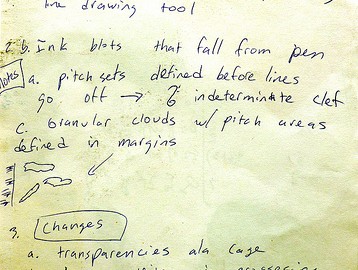
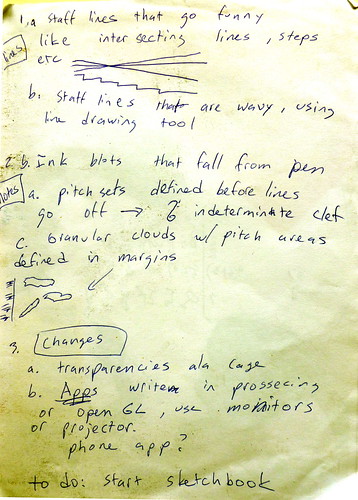
While going through some papers, I found my first notes from when I first thought of this piece.
.flickr-photo { border: solid 2px #000000; }.flickr-yourcomment { }.flickr-frame { text-align: left; padding: 3px; }.flickr-caption { font-size: 0.8em; margin-top: 0px; }


First Notes, originally uploaded by celesteh.

This piece started as a pen and paper idea. The ideas were:

Lines

  1. staff lines that go funny, like intersecting lines, steps, etc.
  2. wavy lines using a line drawing tool.

Notes

  1. pitch sets definied before the lines go off –> indeterminate clefs
  2. Ink blots that fall from an ink pen
  3. granular clouds w/ pitch areas defined in margins

Changes

  1. Transparencies, ala Cage
  2. Apps written in processing or Open GL, use monitors or projector.
  3. phone app?

The staff lines that go off is a good idea. They could start straight and then curve or just always be intersecting. This can’t use the staff notation in the font, but will need to be a set of rules on how to draw lines.
Using indeterminate clefs is not as good an idea – it just means there are two possible versions of every note, which just builds chords.
By the end of making that outline, it was no longer a pen and paper piece!
Granular clouds are not well suited to vocal ensembles, but this idea did become another piece.
Cloud Drawings from Charles Céleste Hutchins on Vimeo.

Fontastic

I’ve got a demo going of the SMuFL font thing here. This is what my style.css looks like:

@font-face {
  font-family: Bravura;
  src: local("Bravura Regular"),
    local("BravuraRegular"), 
    url(Bravura.otf) format("opentype");
}
 
body {
  font-family: Bravura, Sonata, sans-serif; 
}

td {font-size:200%;}

I cheated. Instead of writing the script to generate all the glyphs in javascript, I used sclang because I know it already. This is the code:

i = 0x1D1FF - 0x1D100 + 1;

"<html>".postln;
"<head>".postln;
"<link rel="stylesheet" type="text/css" href="style.css">".postln;
"</head>".postln;
"<body>".postln;
"<table border =1 cellpadding =5>".postln;

i.do({|glyph|
 // unicode music section
 glyph = glyph + 0x1D100;
 "<tr><td>%</td><td>&#x%;</td>".postf(glyph.asHexString(5), glyph.asHexString(5));

 // SMuFL extra music char section
 glyph = glyph + 0xE000 - 0x1D100;
 "<td>%</td><td>&#x%;</td>".postf(glyph.asHexString(5), glyph.asHexString(5));
 glyph = glyph + 0xFF;
  "<td>%</td><td>&#x%;</td>".postf(glyph.asHexString(5), glyph.asHexString(5));
 glyph = glyph + 0xFF; 
 "<td>%</td><td>&#x%;</td>".postf(glyph.asHexString(5), glyph.asHexString(5));
 glyph = glyph + 0xFF; 
 "<td>%</td><td>&#x%;</td>".postf(glyph.asHexString(5), glyph.asHexString(5));
 glyph = glyph + 0xFF; 
 "<td>%</td><td>&#x%;</td>".postf(glyph.asHexString(5), glyph.asHexString(5));
 glyph = glyph + 0xFF;
 "<td>%</td><td>&#x%;</td>".postf(glyph.asHexString(5), glyph.asHexString(5));
 glyph = glyph + 0xFF;
 "<td>%</td><td>&#x%;</td>".postf(glyph.asHexString(5), glyph.asHexString(5));
 glyph = glyph + 0xFF;
 "<td>%</td><td>&#x%;</td>".postf(glyph.asHexString(5), glyph.asHexString(5));
 glyph = glyph + 0xFF;
 "<td>%</td><td>&#x%;</td>".postf(glyph.asHexString(5), glyph.asHexString(5));
 glyph = glyph + 0xFF;
 "<td>%</td><td>&#x%;</td>".postf(glyph.asHexString(5), glyph.asHexString(5));
 glyph = glyph + 0xFF;
 "<td>%</td><td>&#x%;</td>".postf(glyph.asHexString(5), glyph.asHexString(5));
 glyph = glyph + 0xFF;
 "<td>%</td><td>&#x%;</td></tr>n".postf(glyph.asHexString(5), glyph.asHexString(5));
});
"</table>".postln;
"</body></html>".postln;
"";

It’s not the nicest code I’ve ever written.
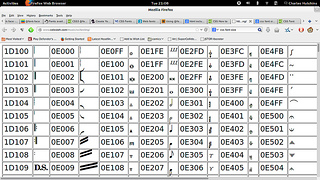
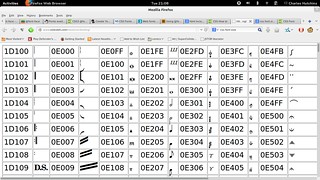
If you click through and see musical stuff at the top of the first two columns, then all is well. If you see non musical stuff, like linux penguins, then the font thing didn’t work. This is what it looks like for me:
.flickr-photo { border: solid 2px #000000; }.flickr-yourcomment { }.flickr-frame { text-align: left; padding: 3px; }.flickr-caption { font-size: 0.8em; margin-top: 0px; }


Bravura in Firefox, originally uploaded by celesteh.

If you’re getting something really different, if you don’t mind leaving a comment about your browser and operating system? This is supposed to work with internet explorer, so I’m interested in the experiences of Windows users and especially of iPad users.
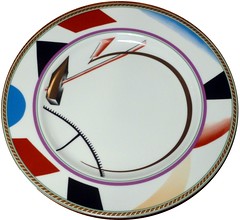
I mentioned yesterday that I was drawing some influence from Russian art of the revolutionary period. This is a picture of a plate originally designed around then:
.flickr-photo { border: solid 2px #000000; }.flickr-yourcomment { }.flickr-frame { text-align: left; padding: 3px; }.flickr-caption { font-size: 0.8em; margin-top: 0px; }


Supermatist Plate, originally uploaded by celesteh.

It’s got a nice mix of abstract and concrete symbols. Also this google search returns a load of suprematist images. There seems to be a clear relationship between those kinds of images and some of Schaeffer’s colour pieces, which are single page graphic scores.
The next steps for me, aside from getting some javascript skills, are picking which of those many many many musical symbols will be in my palette. I can’t just pick randomly within the range, because some of them would be especially nonsensical (like the MIDI cable ones) and not every glyph is supported.
Also, I still need to pick out some text.
Sketches

.flickr-photo { border: solid 2px #000000; }.flickr-yourcomment { }.flickr-frame { text-align: left; padding: 3px; }.flickr-caption { font-size: 0.8em; margin-top: 0px; }


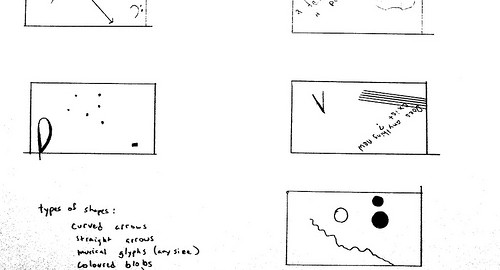
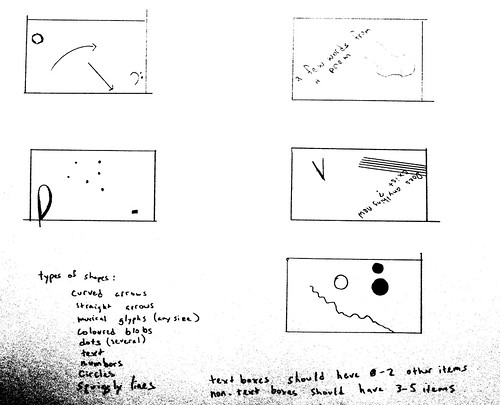
Sketches, originally uploaded by celesteh.

I finally did some sketeches with pen and pencil about what I might do. The gamut of allowable shapes is therefore:

  • curved arrows
  • straight arrows
  • musical glyphs of any size (a list of allowable unicode numbers will be forthcoming)
  • coloured blobs
  • clouds of dots
  • text
  • numbers
  • circles
  • squiggly lines

Boxes that contain text may have 0-2 other items. Boxes that do not contain text may have 3-5 items.
A few of the boxes I drew reminded me of some of the Russian avant-garde stuff, like the Constructivists and Suprematists. This is not a co-incidence since, inspired by the name of my choir, I went to see a bunch of Constructivist work some weeks ago. I’ll post some of the images I’m thinking of shortly.
As far as text goes, I had an idea to use some incantations of C’thulu, but then I realised that’s a terrible idea, so I’m thinking now of some English translations of Constructivist and Suprematist poetry or prose, still about sounding and listening.

OSC and Javascript

Having my mouth cut open took a bit more out of me than I expected. I have nothing new to share about rendering graphics with font symbols in javascript, but here are some js libraries that can do OSC, which will be needed for a later stage of this project. I was looking these up for another project that needs to both send and receive OSC. I don’t want to have to learn two different OSC libraries, so even though this project only needs to receive, I’m only interested in libraries that do both. All of these seem to be built on top of another library called Node.js

  • Kievii does a lot more than I need, but there’s OSC in it too.
  • OSC-web has some proxy stuff which could be useful for later projects
  • OSC-min is a minimal implementation that does everything I need
  • The website for Node.js has a list of popular OSC implementations

Back to rendering graphics soon. I’ve been reading an introduction to javascript, which is way too basic, but a place to start. After that, I think what I need to know about is probably canvas, so I’ll be reading about that.
Also, obviously, I need to think about symbols that are not just bits of music notation font. If I also want to use text, I either need to write some or find something that I can use, such as a philosophical text or poem. If I want the text to be related to the mechanics of the piece, it should be about sounding and listening. There’s some odd text on this theme that I remember from the very start of Noise Water Meat, so I might go looking for that in translation. I really do need to make some paper sketches soon or there’s a risk that I’ll just be making a real-time, machine-listening, pastiche of Redhead and while that would be great fun, I do want to make this my own.
I’m also sort of wondering how I want to page changing to work. Do I want the boxes to just fade in and then fade out? Do I want them to move their location on the screen? Do I want them to change size? Should the elements within them stay fixed? I’m thinking that if the box is moving or changing size, the stuff in it can’t also move or it’s too much.

Creative Pact Day 3

So I’m doing the Creative Pact, but I’m a day behind because I didn’t hear about it until September 2nd. My project is to write a vocal piece wth a computer generated score in real time.
I don’t have a lot to report today. I learned some facts:

  • There is a new release of SCMIR
  • It is totally possible to serve fonts across the web for viewing web pages. You use a thing in CSS called @font-face
  • There is a new initiative for standardisation in music fonts called SMuFL (pronounced ‘smooful’). Compliant fonts implement the unicode section for music fonts and then have a bunch of additional musical symbols.
  • The font that ships with LilyPond, Bravura implements SMuFL and looks alright.
  • (The tattoo on my arm is bass clef in the font that shipped with Sibelius 3. What font is that?)

I can’t do a proper demo of this because fonts included in a web page need to be served from the same server as the webpage (at least for firefox users), but this style.css bit sets the font to Bravura for the whole of a webpage:

@font-face {
  font-family: Bravura Regular;
  src: local("Bravura Regular"),
    local("BravuraRegular"), 
    url(Bravura.otf) format("opentype");
}
 
body {
  font-family: Bravura Regular, Sonata, sans-serif; 
}

That uses the local copy of Bravura, if it’s already on your machine, or downloads it if not. If somehow that goes wrong, it uses the Sonata font instead. When I get a chance, I’ll upload a proper demo to my website, doing a table of all the musical symbols. But probably not tomorrow, as I’m going ot have dental surgery in the morning and will probably feel rotten later in the day.

Anxiety and Musical Form

My gf asked me why I don’t blog about having anxiety. There’s a few reasons I haven’t mentioned it much of late. Part of the reason for this is that while it shapes a certain amount of my experience, I absolutely do not want it to become a point of identity. Partly, I’d rather talk about things that are more interesting, like music. (There’s nothing quite so boring as other people’s health problems.) And maybe most importantly, I’m embarrassed about it.
But yeah, something about my fight-or-flight response is not working correctly and I get panic attacks.
I’m going to get a referral for CBT – cognitive behavioural therapy, which has been shown to be effective. I kind of know what leads to them. If I’m stressed or not eating right or especially if I’m short on sleep, I’m much more likely to get them. I read some place that they normally last about half an hour and I don’t know if this is true or not, but I do know that if I wait and take deep breaths, they tend to go away.
In case you’ve never had a panic attack, (lucky you), I shall attempt to describe it. For me, it is what it sounds like, a sudden stab of panic. You know when you go out and you’re nearly to the tube station and think, ‘oh my god, did I leave the stove on?!’ It’s like that, but I tend to think maybe I have cancer or something. While one can turn around and go home and check if they’ve forgotten a pan of beans bubbling away, one can’t do that with a sudden fear of dread disease. So I try to talk myself out of it, but can get into a loop: ‘I’m fine because of X. But what about Y?’ Repeat for several minutes. This is very annoying. Especially when I know I’m in a loop. I know I’m being irrational. But I can’t seem to shake it. Because what about Y??! And maybe it just goes away quietly, or maybe I start shaking and phone NHS Direct.
What sets these off? Sometimes it’s because something is actually wrong with me. And, indeed, when I said I phone NHS Direct, this is actually not entirely true – I have a stone in one of my spit glands. It hurts occasionally and once in a great while, it blocks something and swells a bit. Eventually, somebody is going to remove it. But anyway, one day, before it was x-rayed, my neck swelled slightly and I saw it in the mirror and went into a panic. Sure, the dentist said he thought it was probably a stone, but what if it’s actually a terrible infection that’s spread to something important in my neck before it turns into blood poisoning or gets into my brain and might kill me by morning. (‘I’m fine because if I had a horrible infection, I would have a fever. But what about my swollen neck?’ Repeat for several minutes.) It was a Friday evening, so I phoned NHS Direct and they said it sounded like something that might happen with a spit gland stone and if it hadn’t gone down by Monday morning, I should ring my dentist. This was exactly the calm reassurance I wanted from the NHS. (God bless the NHS.) Then, unexpectedly, they started reading a list of diseases that might be associated with swollen necks. Glandular fever. (Mononucleosis to Americans.) ‘No, I already had that.’ Mumps. ‘I’m vaccinated.’ Meningitis. ‘Doesn’t that usually have a fever?’ I was starting to get alarmed. The woman on the phone was starting to get annoyed. She just had a script to read through (I guess so nobody can say they weren’t warned?) and didn’t want to be interrupted. Lupus. ‘Wait, what? How do I know if I have lupus??’ I hadn’t even considered this possibility. The woman sighed in an irritated manner. I have not rung the NHS Direct since.
Most often what sets off a panic attack is that I’m trying to ignore some emotion I’m having. Something has upset me. I don’t want to deal with it. I tell myself I’m fine and carry on. And then: ‘Wait, what if that cat I just pet has rabies?’ Sometimes, I can identify what emotion or thought I’m trying to nullify and go deal with it and be fine. Often it’s just some really small erasure. Very often, I’m not even aware that I’m doing it. Some part of my brain has intercepted my experience and tried to overwrite it and I haven’t even noticed. This is what I hope CBT can help with, since I really want to stop doing that. I mean, I don’t like having negative emotions, but they’re vastly preferrable to panic attacks.
Also, these erased emotions are sometimes important ones, but often are fairly small. So let’s say I’ve read something that reminds me of LGBT-phobia in schools and its affecting and I just don’t feel like thinking about that at the moment, so there’s an erasure. ‘What if that friendly cat is actually rabid?’ I try to ignore the thought, so there’s another avoidance. ‘I am feeling panicked about this cat and this is stupid, so I must try to hide it or else everyone will know I’m crazy.’ And thus something small builds.

Musical Forms

I did my undergraduate music education sort of the wrong way around. I didn’t expect to want to get a degree in it, so I started by taking all the upper division classes and seminars because they were most interesting. So I learned about how John Cage rejected all the old way of doing things that were not useful any more in the 20th century. Music theory is a old and unneeded! I accepted this at face value. (Never mind how a lot of minimalists, who I loved, worked a lot with harmony.) Then, after I decided I wanted to get a music degree, I had to take all the first year classes in counterpoint, history and all of this stuff I had already rejected. I insisted that John Cage had said it was useless. My teachers disagreed, but since they were the same ones who had told me a few months earlier that this was the stuff of the past, I felt their position was somewhat weakened. Anyway, I graduated, having learned as little traditional stuff as possible.
It wasn’t long after graduation that I became aware that perhaps I had been overzealous in my embracing of Cagean values. I wanted to write something harmonic, but all I actually knew how to do were chorales and I didn’t even know most of the rules for them. How to structure anything was a mystery. I know that forms existed and they had names, but what those meant, I had no idea.
I got to grad school (a decade ago) and somebody commented that everything I wrote was in sonata form. I had no idea. Maybe I should mix this up a bit more? I didn’t know any other forms.
Obviously the thing to do about this gap in my knowledge was to feel deep shame and attempt to hide it. So rather than read a book or ask a teacher, I just hoped nobody noticed how I was nowhere near good enough to actually be qualified to be in an MA program. (To be fair, I was REALLY busy trying to learn every other thing that everybody around me already seemed to know.)
At some point, I finally learned that while there are named forms that exist, form is arbitrary. It’s just any structure you can use to make sense of things. It can sometimes be implied by the material, or it can be decided in advance. Some Cage pieces are all about form. They are vessels into which you can pour any material and the structure somehow causes the material to sound better. Forms are like that. I don’t feel worried about them any more and while my classical vocabulary is still a bit lacking, I’m not overly concerned about this. Anyway, since I moved to England, I don’t even know note names any more, so not knowing how to organise a minuet is somewhat less important than not being able to remember the duration of a semi-quaver or a minim.
If you are hoping for some insight: The important thing to remember about structures is that they fix musical problems. This is how to write a piece of music: Put your material into a structure, then get the ending perfect, then get the beginning nice, then do the middle bits. Then write some glue to hold everything together. If your middle section is supposed to be 5 minutes long but is getting dull by minute three, you can either make it shorter or subdivide it – so instead of being one long thing, it’s got an ABA or ABC structure within it, so it moves between related ideas. That is to say, add some stuff.
As I recall, Cage didn’t talk much about the importance of structure directly, but he implied the hell out of it. Lecture on Nothing is nothing but structure. This is much more vital than the ‘ignore harmony’ that I first got from my youthful introduction. I was over-eager to be freed from a prison I’d never even been in. But aren’t we all? Especially when we’re young.

What’s the Connection?

This post is in AB form, with a small coda.